Most AI projects stop at the pilot stage because implementation relies on people and processes. Four leadership mistakes and what I do differently to make AI work.
Krystian Wydro - AI Creative Director, OtterMind
◆◆ 8 min read
AI implementations usually stall at the organisational level: a company buys access to tools but leaves processes, security rules, and the way people work unchanged. BCG estimates that 70% of the work in AI implementation is people and processes, while algorithms account for merely 10%. Below are four of the most repeated mistakes, along with what I do differently.
Ask people what they already use. Do this before buying anything new.
Choose 2-3 specific processes with a real problem over "AI across the whole company".
State clearly what it is for. If keeping jobs is the goal, write it down and stick to it.
Allocate time for learning. Training on the team's materials and tools, in groups according to skill level.
Appoint ambassadors in teams and give them a space to share what works.
Measure the time to an approved deliverable over the number of logins.
Revisit this every quarter. Tools age faster than plans.
02 - Scale of the problem
What keeps most AI projects stuck in the pilot phase?
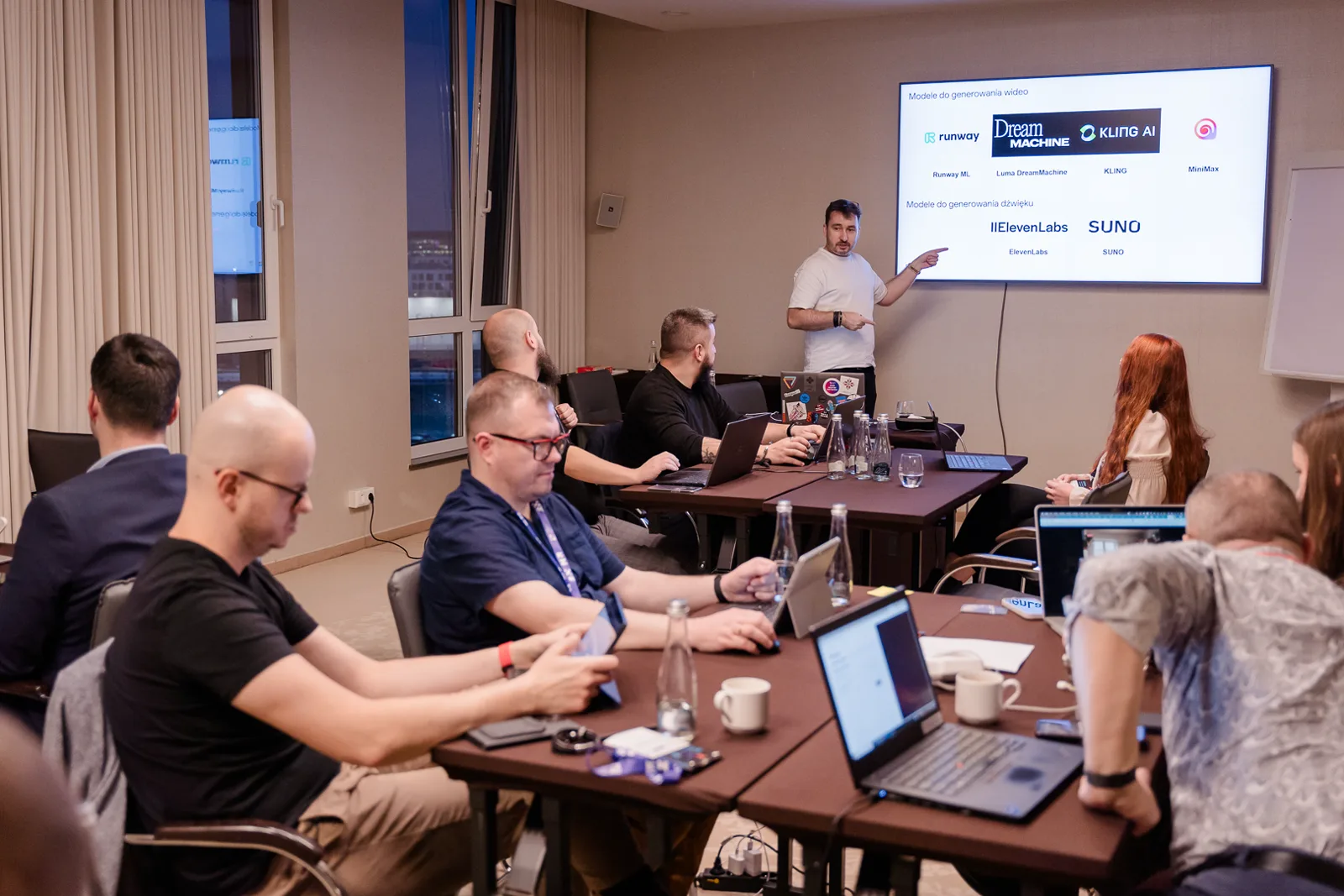
Workshop at the PMI Poland Chapter Congress, 2024
A pilot tests the tool, but the organisation dictates the scale. The MIT NANDA report The GenAI Divide: State of AI in Business 2025 (Challapally, Pease, Raskar, Chari, July 2025) states that 95% of companies see zero financial impact from formal AI investments (discussed in Fortune). S&P Global Market Intelligence, in a study of over 1000 companies from North America and Europe (March 2025), reports that an average of 46% of proofs of concept are abandoned before implementation, and the percentage of companies withdrawing from most AI initiatives has grown from 17% to 42% (Cybersecurity Dive).
Many companies take the same standard path: they buy popular tools, delegate tool selection to IT, direct the budget where the effect is immediately visible, and sometimes start with staff reductions. Each of these steps makes logical sense in isolation. Together, they create an implementation that changes nothing.
When I join a team, I start with a diagnosis taking 1-2 weeks: talking to people, reviewing processes, and auditing tools already in use. The plan emerges only from this foundation.
03 - Diagnosis
Is the problem with the technology or the organisation?
The organisation. BCG phrases it like this: algorithms account for 10% of the work in an AI transformation, technology 20%, and the remaining 70% is people and processes (BCG, 2025). The MIT report calls the main cause of failure the learning gap: tools fail because they fail to learn, adapt, and integrate with company processes, whereas the models themselves are good enough. General tools work well for individual users due to their flexibility, but they lose their edge in corporate applications because they forget the context.
AI leaves broken processes unresolved. It will accelerate and scale them, along with their flaws.
04 - Mistake 1
Access versus implementation: how do they differ?
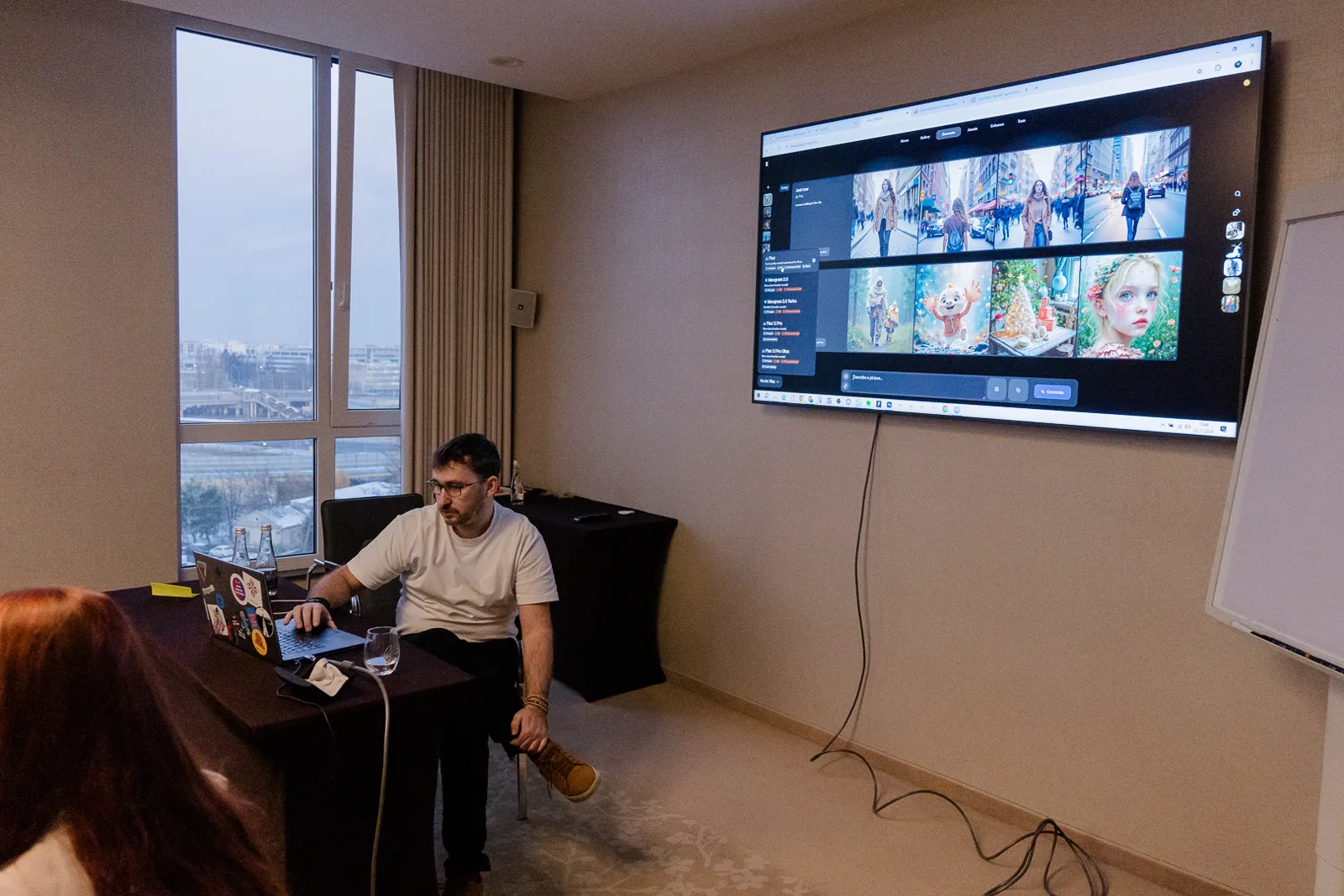
Live demonstration during a workshop, PMI Congress 2024
A licence provides access, whereas implementation means changing the way people work. Buying a tool leaves the business model and team habits unchanged. Prompt writing skills fall short when the tool lacks business context, such as brand rules, clients, and the approval process.
From practice: I start with the process and choose the tool last. I take one repetitive task, describe it step by step, and only then select the tool. The company's context (brand style, rules, examples) goes into a shared library of prompts and working standards, leaving nothing trapped solely in individual minds.
05 - Mistake 2
What is shadow AI and how to handle it?
Participants' work, PMI Congress 2024
Shadow AI means using AI tools outside the company's official list. According to the MIT report, about 40% of companies have purchased official subscriptions to large language models, while employees in over 90% of companies regularly use their own AI tools for work via personal accounts on ChatGPT, Claude, Gemini, or Copilot. The reason is simple: a top-down selected tool can be confusing or misaligned with needs, prompting employees to reach for their own.
An IT block fails to stop this. It merely silences the conversation about what people are actually doing.
From practice: I start by asking "What are you already using and what does it give you?". This is the cheapest audit I know. It highlights what works and helps decide what to regulate and what to support. The rules – detailing what is allowed, with what data, and in which tools – are something I establish with the team and IT during an AI implementation.
06 - Mistake 3
How to relieve the team's fear of AI?
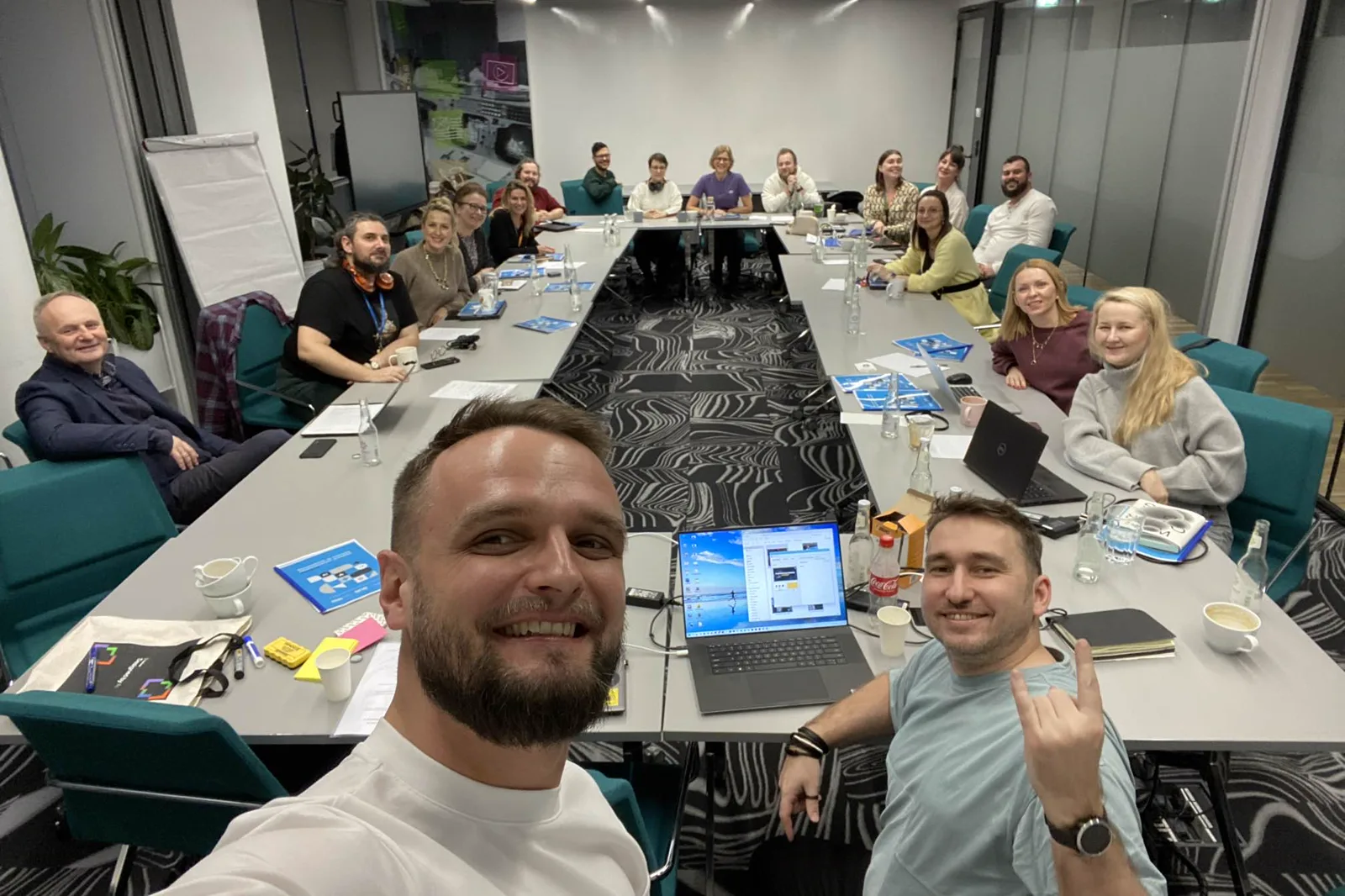
Training for RASP, 2024
An employee convinced that AI intends to replace them will refuse to learn it or disclose how they use it. Research by EY (July 2024, 4741 employees across nine European countries) shows that 68% fear losing their jobs due to AI (EY). Poland was absent from this sample, yet the figures highlight the scale of the phenomenon. Amy Edmondson demonstrates that psychological safety determines whether people ask questions, admit mistakes, and propose unconventional ideas. Missing this removes experimentation, which in turn stifles innovation.
The MIT report highlights an interesting detail: in companies succeeding with AI, savings stem primarily from reducing external expenses, namely business process outsourcing (BPO) and agencies (up to 30% lower agency costs). The internal team remains safe from cuts. This is why I tell teams directly: AI aims to take over tedious tasks and reduce some external costs.
From practice: I celebrate experiments, including failed ones. A team treating a mistake as data learns faster. Practically, I select ambassadors who genuinely want to engage with the topic (otherwise they lack credibility), and I provide a shared space where people exchange discoveries and prompts. Some organisations reward this through gamification.
07 - Mistake 4
Which processes should receive the AI budget?
According to the MIT report, over half of generative AI budgets go towards visible functions like sales and marketing, even though back-office automation – operations, finance, and legal – often delivers the highest return. Marketing makes sense, but selecting a process should rely on costs and time, rather than what looks good on a board presentation.
From practice: I focus on a few heavy, high-value processes simultaneously, ignoring the rest. Companies that succeed benefit from abandoning the chase after every single use case. They select a few difficult processes that previously caused trouble. I describe how to involve the team in this in my article on implementing AI in an agency and marketing department.
08 - Measurement
How to check if AI truly delivers value?
Measure the time to an approved deliverable. The number of logins only shows that someone opened the tool. The time from briefing to approved result reveals if the work is genuinely faster. A team claiming they "did it faster in Sheets" remains correct until someone measures both paths.
I measure three things: the time taken for a single task before and after, the number of revision rounds, and whether the decision-maker approved the material. The results return to the team as a feedback loop: we compare the actual outcome with expectations and refine the process. Missing this loop leaves the implementation stagnant.
Multi-year plans remain impossible to maintain anyway, as tool knowledge ages in months. The ability to learn and adapt provides the real advantage. A leader manages the transformation of people, processes, and culture, treating AI as a competency to teach rather than a tool to install.
09 - Experience
Who have I tested this with in practice?
The approach described above stems from working with teams, coming straight from practice. Below are the programmes and companies where I have taught and implemented AI, including those where establishing rules for AI usage played a major role.
Where
What I did
Google and SGH, "Umiejętności Jutra"
Three cohorts as an AI graphics and video trainer. Over 100,000 people have completed the programmes I taught in.
Google and Salestube: Groupon, Allegro, Autodoc
Dedicated, advanced AI training tailored to the team.
RASP
Dedicated training with a separate module on AI usage rules: the AI Act, GDPR, and internal company regulations.
ORLEN, IKEA, Danone Nutricia, Kodano,
Dedicated training for teams
IAB Polska and DIMAQ AI
Member of the Programme Board for the DIMAQ AI certification and co-author of the 300-page Guide to AI 2.0 (including the chapter on creative leadership)
Tourism Organisations
Podkarpacka Regionalna Organizacja Turystyczna and Dolnośląska Organizacja Turystyczna
10 - Checklist
What leadership mistakes do I see most often?
Buying licences missing a training plan and a designated owner.
A single "correct" tool forced upon the entire company.
Delegating everything to IT, even though the decisions affect business processes.
A redundancy announcement or the lack thereof, which people interpret in their own way regardless.
Training "about AI" over training on the team's specific tasks.
11 - FAQ
Most frequent questions about AI implementation in a company
What prevents AI pilots from moving into production?
Usually, a process owner, learning time, and adequate quality data are missing. Testing a tool comes easily, whereas changing the working method requires human decisions and attention. According to S&P Global, an average of 46% of proofs of concept are abandoned prior to implementation.
What is shadow AI and should it be banned?
This entails using AI tools outside the company's official list. A ban alone rarely works. It proves better to check what people use and build rules around that.
Will AI take my employees' jobs?
Promising this for the entire economy remains impossible. Within your company, however, you can clearly define whether the implementation aims for reductions and communicate this to the team. Ambiguity alone blocks adoption.
Where to start implementing AI in a small team?
With one repetitive task and asking the team what they already use. Only then comes tool selection and training based on that task.
How long does AI implementation take in a creative team?
It depends on the scope. My projects take between 1 and 6 months: diagnosis 1-2 weeks, strategy a week, implementation 4-8 weeks, and an audit after 30 days.
I implement AI in creative and marketing teams using the model described on the AI implementation page, and I teach teams how to work with the tools the company already owns through training sessions.
I use essential cookies. With your consent I'll also enable analytics and marketing cookies. Privacy policy